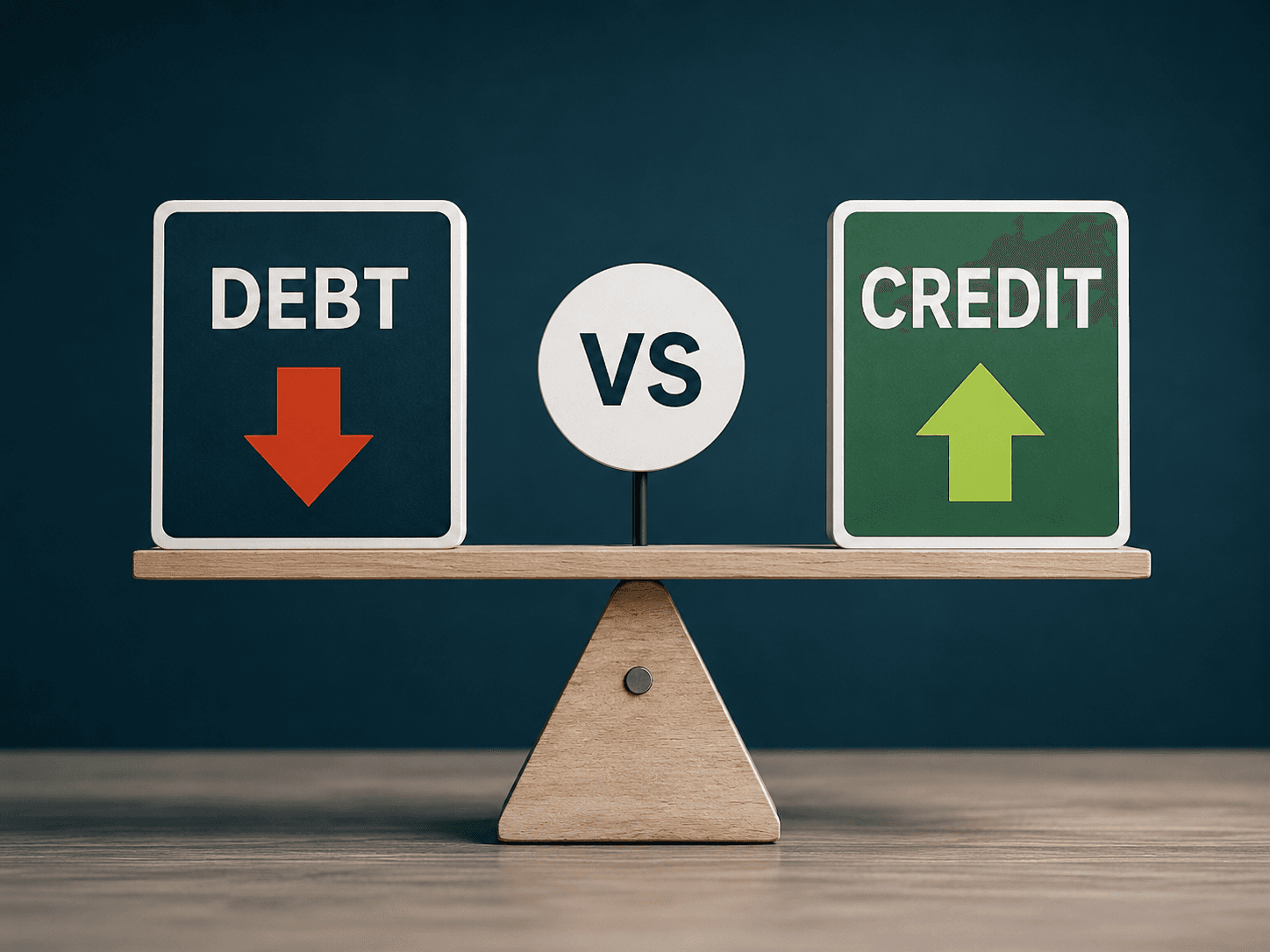
Picture this: you’re standing in an electronics store staring at a $1,000 laptop. You don’t have the cash in your wallet, but the clerk tells you, “You can take it home today and pay later with a credit card.” That one swipe sets off two different stories—one about credit and one about debt.
Credit, at its core, is about trust. When a bank or lender gives you access to money, they’re saying, “We trust that you’ll pay us back.” It’s like being handed a hall pass in school—you’ve been given permission to move forward. Every time you use a credit card, take out a loan, or sign on a car lease, you’re tapping into that permission. If you pay it back on time, you’re rewarded. Your track record gets recorded in a credit report, which is then distilled into a number called a credit score. That number becomes your financial GPA, a shorthand that tells banks, landlords, and even some employers whether you can be trusted. A strong score can save you thousands of dollars over your lifetime. Imagine two friends both buying cars. One has excellent credit and gets a $15,000 loan at 5 percent interest. The other, with poor credit, is offered the same loan at 15 percent. Over the course of a few years, the first friend may pay only a few thousand in interest, while the second ends up paying nearly double. The difference is not about the car—it’s about how they handled credit.
Debt is the other side of the story. The moment you borrow money and don’t pay it back immediately, you move from credit into debt. If you put that $1,000 laptop on your card and pay the bill in full at the end of the month, you use credit without falling into debt. But if you carry a balance, interest begins to pile on. That laptop might quietly cost you $1,200, then $1,500, all because you didn’t settle the bill. Unlike credit, which is about access, debt is about obligation. It is the weight you carry from past choices, and depending on how heavy it becomes, it can either be a useful backpack or a burden that slows you down. Note, debt is not the same as debit. A debit card pulls money directly from your checking account, meaning you can only spend what you already have. Debt, on the other hand, is money you owe because you borrowed it in the first place. One reduces your balance immediately; the other creates a bill with added interest that you’ll have to deal with later.
Not all debt is created equal. A student loan that allows you to finish college and earn a higher salary can be seen as productive, because it creates opportunities that outweigh the cost. A mortgage can help you buy a home that grows in value over time. But high-interest credit card balances or payday loans rarely lead to anything lasting; they just trap you in a cycle of repayment. What makes the difference is whether the debt helps you build something of value or simply funds short-term wants.
Credit and debt are inseparable, like fire and smoke. Credit gives you the fire—the ability to build, to create, to move faster than your cash flow might allow. Debt is the smoke that follows when that fire isn’t managed carefully. Some smoke is inevitable; almost everyone will carry some form of debt in their lifetime. But too much smoke clouds your future and makes every step harder. Paying attention to the balance is what separates people who use money as a tool from those who feel weighed down by it.
In the end, credit is the doorway, and debt is the backpack you carry through it. Walk through lightly and wisely, and that backpack will hold tools that help you go further. Overload it with bricks, and every step will feel heavier than the last. The goal isn’t to avoid credit, but to handle it so well that debt never grows into a burden. Every swipe of the card and every payment you make is shaping the story of how you’ll carry money into the future.