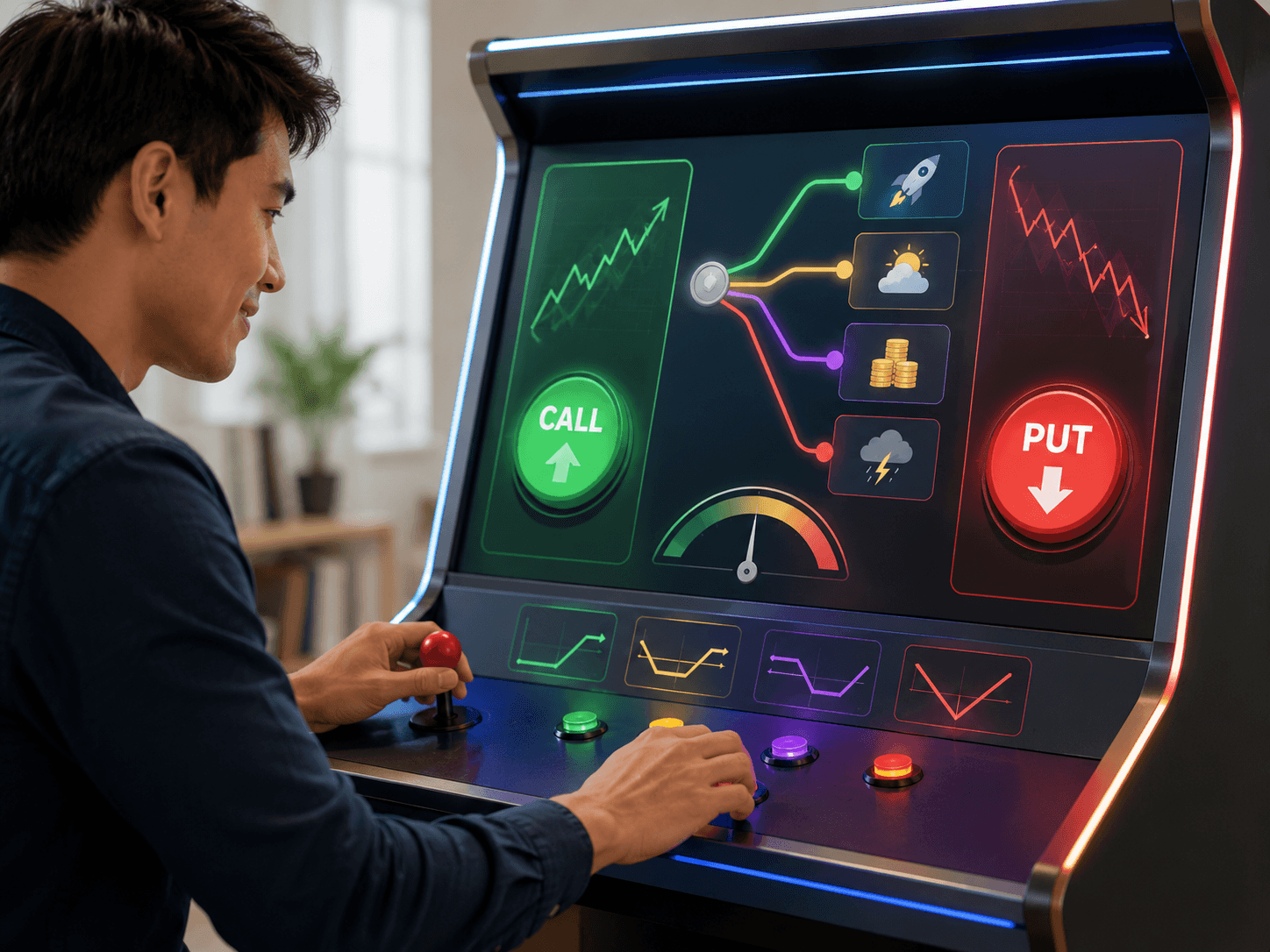
When you step into an arcade, the first things you notice aren’t the prizes on the wall but the flickering machines, the clattering tokens, and the noise of a hundred games being played all at once. Nobody walks into an arcade ready to exchange cash for a teddy bear. Instead, they buy tokens—small coins that give you the chance to play. That’s what options are in the investing world. They’re not the stock itself but a contract that gives you the right, though not the obligation, to buy or sell stocks at a set price before a certain date. Like a token in an arcade machine, an option doesn’t promise a win, it only opens the door to a possibility.
The comparison starts with the price of admission. In an arcade, each token costs money. Once you’ve slid it into a machine, it’s gone forever. Options carry the same rule. The premium you pay to buy one is not a down payment, it’s a fee—money that disappears whether you win or lose. Many new investors are drawn to options because the premium looks small compared to the cost of buying shares outright, but just like spending tokens on flashing games, those small costs add up quickly when you play without understanding the rules. Imagine a stock trading at $100. A call option giving you the right to buy it at $110 might cost $5. That $5 is your token. If the stock never climbs above $110 before time runs out, the token is gone. Nothing is refunded.
At the far end of the arcade, the prize wall looms. Plush toys, shiny gadgets, neon trinkets all tempt you from behind the counter. These are the underlying stocks. They’re the real rewards, the assets that everyone is trying to acquire, though buying an option doesn’t mean you already own them. Instead, the contract/token gives you the right to claim them at a predetermined level, if you can hit the score. A call option is the equivalent of winning enough tickets to buy a prize at a bargain, betting that the stock will rise high enough that the option becomes valuable due to the reward becoming cheaper. A put option works the opposite way. It’s like having a ticket that lets you return a prize for full value even if everyone else in the arcade has decided it’s worth less. If the stock’s price falls, your put option lets you sell it at the higher price you locked in, protecting you from the drop. Both routes point back to the prize wall, but the path you choose depends on whether you are playing for a climb or a drop.
Anyone who has ever spent time in an arcade knows that tokens alone are not enough—you have to beat the game. Each machine demands a score before it spits out tickets, and that score is like the strike price in an option. Imagine again the stock at $100. If your call option has a strike at $110, you only start winning if the stock passes that mark. Suppose the stock jumps to $120 before expiration. Your option now lets you buy at $110 and immediately sell at $120, giving you a $10 gain. But because you spent $5 on the option itself, your net gain is $5, essentially doubling your money. That’s the thrill of beating the game: one well-played round pays out more tickets than you thought possible. Of course, if the stock stalls at $108, just shy of the mark, you get nothing and you net at negative $5. Just like missing the high score by a few points, being close doesn’t count. Note that one benefit of options is that you are never required to act on them. If the stock moves the wrong way—say it drops to zero—you can simply walk away. The most you ever lose is the premium you paid for the option, nothing more. That limited downside is what makes options appealing, even though the tokens can disappear quickly if you play without a plan.
There is also the matter of time. Every arcade game runs on a clock. It doesn’t matter how close you are or how much progress you’ve made—when the countdown hits zero, the chance is over. Options live by the same countdown. Each contract has an expiration date. Some last a week, others a month, some half a year or more, but when the timer runs out, the option disappears. A long clock costs more because it gives you extra chances, just as an arcade game that lets you play longer for each token feels like a better deal. A short timer is cheaper, but unforgiving. No matter how close the score, when the clock hits zero the option is worthless.
And not every game is built the same. Skee-Ball feels steady and predictable—you know how the ball will roll. Whack-a-Mole is chaos, with targets popping up at random. There is volatility in the market. Some stocks barely move from day to day, and the options tied to them are inexpensive because the game feels tame. Others swing wildly, their prices jumping and crashing without warning, and the options on them are expensive because the game is unpredictable but thrilling. Investors pay more tokens for the chance to play in chaos, because if they manage to hit the target, the tickets pay out bigger.
So why step into this arcade at all?
For some, the answer is leverage. With a handful of tokens, you can control access to far larger prizes than you could afford by paying cash. Buying 100 shares of a $100 stock outright would cost $10,000. But buying a single call option priced at $5 only costs $500, since each contract covers 100 shares. That $500 gives you the right to benefit from the movement of all 100 shares, even though you don’t own them outright. If the stock climbs to $120, the option’s value rises to about $10 per share (assuming the strike price is $110), or $1,000 total. Your $500 stake has increased by 100%. In arcade terms, it’s like spending a single token for a shot at the giant prize that normally takes a bucket of coins to win.
Others come for protection. Imagine already owning the stock at $100, worried it could fall. By buying a put option with a strike at $95, you’ve guaranteed that no matter how low the stock sinks, you can still sell at $95. If the stock drops to $80, your put cushions the blow, the way an arcade might hand you a few tickets just for playing, even if you lose the game. In this sense, options are insurance, tokens spent to reduce the sting of bad luck.
Of course, there are also the pure gamblers, the players who thrive on speculation. For them, the arcade is a thrill in itself, a place to flip a small pile of tokens into a mountain of tickets if luck and timing break their way. Sometimes they walk out with armfuls of prizes, other times with nothing but empty pockets. The market doesn’t care either way.
But the arcade has a catch, one that seasoned players know well. The lights are designed to draw you in, the machines to keep you playing, the odds to favor the house. Options have the same pull. They dazzle with the promise of big wins, but the math behind them is often against the casual player. Without discipline, the premiums you pay vanish into the system faster than you expect. That doesn’t mean they are useless. In skilled hands, options are powerful. They can protect portfolios from shocks, amplify gains, or generate income when used with strategy. Yet they remain unforgiving. The timer will always hit zero, the strike will always matter, and the tokens will always be spent.
When you finally leave the arcade, your pockets are lighter, your fingers smell faintly of metal, and maybe, if you played with care, you have a prize worth showing off. Options leave investors with the same feeling. They make the market exciting, a place of skill and chance, timing and strategy. But they are not free tickets. They are tokens in a noisy arcade, valuable only if you know the games you are playing.